
Specialization is King
A Q&A with Mark Henley of Henley Workshop.
There are many motivations that drive an affinity for a clothing brand. Maybe it has compelling heritage, or perhaps it’s just something in the air. Sometimes the allure of a brand lies in its interesting point of view or feeling. Mostly, though, I find myself drawn to labels that focus on the product and offer a genuine connection to the founder. That’s what led me to Henley Workshop, a tiny new label making chinos in New York City.
You might be surprised to learn that I only discover a handful of brands each year that I actually want to buy. I’m always trying to find small, maker-led brands that are product-first and not overly obsessed with marketing. Of course, quality is the best economy, and it is worth investing in good things that will last. It’s also important to think about who is behind a brand, and when it’s a tiny operation, your support means more. Sometimes, in our logistically sophisticated world with one-day delivery, we forget to appreciate the maker driven not by economics but by passion. That’s exactly why I appreciate brands like Henley Workshop.
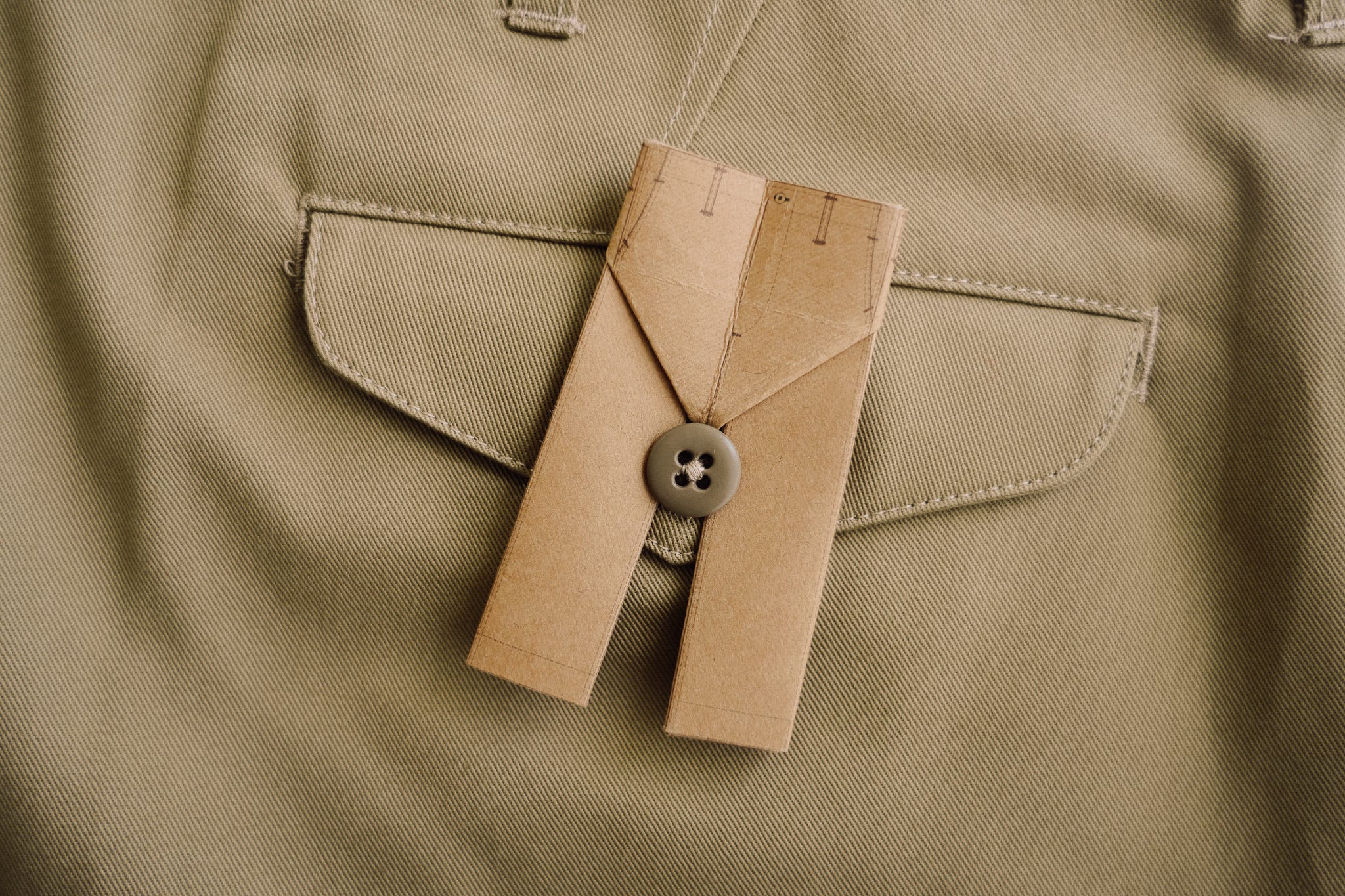
The label was founded last year by designer Mark Henley, who is a vet of both Ralph Lauren and J.Crew. He wanted to create a middle ground between vintage Military chinos and modern trousers. The resulting designs are carefully deliberated and detail-obsessed. Made in NYC using a beautiful Japanese “Rhino” cloth, these chinos are classic yet wearable. Designed with shrink-to-fit in mind, these aren’t skinny technical trousers. They remind me a bit of the cult J.Crew Selvedge Chino in terms of feel and details, but these offer a fuller fit with better details.
The discovery (thanks, Spencer) of Henley Workshop reaffirmed to me that specialization is indeed king. I love it when a designer clearly nerds out and just makes something out of pure passion. That’s exactly what you find with these first chinos from Henley Workshop. When I saw the website, I knew I was going to like these pants, and when they arrived, I was blown away by the details and construction. I wanted to talk more to Mark about what motivates him and why the world needs more chinos in 2026. It was great to hear more about what went into building this brand. Our Q&A is below.


ACL: Why a chino brand? What did you see missing in the market?
Mark Henley: I guess I’ve just had an affinity for vintage military chinos for a long time. Probably because of their ease, durability, and versatility. There’s something really appealing about their simplicity and universality. With a good pair of chinos and a white t-shirt, you don’t really need to know much else about clothing — it’s a solid foundation to build off of. There’s also a lot to dig into and riff on from a design/making perspective. I’ve always tinkered around with making patterns and samples and always gravitated towards pants, maybe because they feel substantial. I also felt denim, shirts, and most other things are pretty well covered already.
To be honest, I didn’t really think too much about a market opportunity. It was more along the lines of wanting to create something I like at a high level for others. I think there’s still room in the world for a really good military-style chino. For a while now I’ve pretty much only found them in Japan. I think it’s a hard thing to find here. There’s definitely some decent chinos on the market, but for me there aren’t any that check all the boxes.
ACL: You have a history of working for some truly great American menswear brands — how are you approaching product differently with your own brand?
MH: It’s a much more hands-on and product-first approach. I really just wanted to be more connected to the product and process, to better understand and control the variables and take the time needed to develop something until it’s right without the restrictions of deadlines, costs, groupthink, etc. Hopefully done with a human touch and lyrical quality without screaming “handmade.” I’m not really interested in creating a collection/line. It’d be fun, but I feel at this point it would just be creating a bunch of stuff for the sake of newness. The story of products and how they’re made is what I find interesting, at least at the moment. I just want to make something simple, but to a high level, which I think a lot of people, especially in fashion, have a hard time seeing the value in. I think they think “basic”, but for me I want the things I use regularly to be enjoyable to use, last a long time without a lot of maintenance. To me that’s interesting, that’s worth something — something you can enjoy on the regular. And I know it’s not for everyone, but my hope is that someone that likes really well-made, considered, classic things will see the value in it. With that said, I still have a long way to go. And I’m still going to put out new and novel things. I just want it to feel like a natural progression and not forced.
It’s probably obvious I never went to business school…lol
ACL: Do you have plans to expand into other categories?
MH: I’m trying to keep it simple and focused right now. I have other pant and short styles ready to go, but they’re kind of riffs on the chinos or other military/work/sports designs. I only have so much bandwidth and want to focus on this area to really try to get it right first. It gets monotonous at times, especially when talking about it, but I don’t think I’m at the point where I’m ready to move on yet. I still have a lot to figure out and get right with what I’m working on now. Between fit, fabric, and design, there’s a lot to stay engaged with. I also love being hands-on with making patterns, trying different fabrics, mockups, samples, and custom orders, so that takes up a ton of time/energy. Plus, there are people out there who do most other categories really well already, and I don’t know if I have much to add.
Time changes everything though, so we’ll see, but that’s where my head’s at right now.
ACL: What does Made in USA mean to Henley?
MH: Expensive, painful, limiting, and underappreciated...lol…
For me, the number one thing is being able to stay hands-on and be involved with the product making. I’m fortunate that I can be at the factory in under an hour. I can regularly check on things, inspect production, fix issues on the spot, ask questions in person, work on things in person, meet the people that are working on it, see how it’s being made, etc. For me that’s kind of what it’s about at this point. It’s probably also a little bit selfish because I don’t want to be stuck designing behind a computer; I prefer and find it more interesting to be hands-on.
Also, there is something inherently authentic and interesting about making something where it originated from, similar to Scottish shetlands, French chore jackets, Spanish espadrilles, etc. I know most people these days don’t really care about that stuff, but I find it interesting and I think it adds a little flavor. My motives aren’t nationalistic at all, I just want to make a product that feels authentic and special and this is how I feel to do that, it’s part of the story. But it’s tough, you have to work really hard not to get mediocre results and it’s expensive, especially in the New York area.
ACL: In your opinion, where are we at with the giant pants thing? How soon can it be done? LOL
MH: Maybe we should start buying stock in fabric mills? I have a feeling it’s going to be around for a while, but hopefully we can reach a happy medium sooner than later. I’m horrible at these trend things, though, so don’t take this as financial or fashion advice.
ACL: How would you describe the fit of these pants and who is the guy in your mind who would wear these?
MH: I describe the fit as classic veering towards the traditional. I’ve tried to find the balance between comfort and a clean look. With this in mind I made them a little fuller in the seat, hips and rise to allow movement, and then the leg has a slight taper to the bottom following the natural shape of the body. The rise is meant to be a little longer, but not so long that you have to wear them at your belly button.
In the last few years I’ve read a lot of tailoring books/material, old and new, specifically on pant patterns/fitting, and the reality is there’s always some trade-off between comfort and a clean look. It’s especially hard because the body is constantly putting pants into so many different configurations, so what looks and feels good one way may not when you shift a different way. Also, everyone is a different shape and has a different opinion on fit, so the challenge gets exponential.
It’s one of the things that keeps pants really challenging and interesting.
It probably sounds cliché, but I hope anyone and everyone can wear them. If someone prefers a more relaxed chino they can size up and it will still have a nuanced shape without being clownish. They’re not a slim fit though, so if that is the preference then it’s probably not the right pant for that look.
The person I have in mind is just someone who appreciates well-made things, how they’re made, and who’s making them.
ACL: What inspired these pants specifically? I’m just curious about where your inspiration came from.
MH: The main inspiration is the original military field chino from the 1940s; for me, that’s the one. Specifically, the one made to the original specifications, which featured flat-felled seams, a grown-on waistband, etc. But I didn’t want to just create a reproduction, so I’ve tried to improve on that without changing the look or spirit of it too much. Updating internal things like clean finishing the fly, doing peached pocket bags, updating the fit, shuttle loom labels, etc. The originals were made en masse and most pretty crudely, though durable. It’s probably kind of ironic to make them in small batches and MTO.
In a bigger sense, the inspiration for the project came from visiting Nakashima’s studio, reading books on Maloof, Esherick, Heath, David Pye, etc. That kind of Studio Craft, maker/designer movement has been a pretty big inspiration and a catalyst for wanting to get more hands-on with product and make things from the inside out. It’s not a perfect translation to what I want to do, but I hope I can keep some of those elements in my work.


I really enjoyed this. I can't quite put my finger on it, but something feels very authentic about how Mark discusses his approach. You also asked the right questions that I cared about.And I learned a lot from the subtle comments in the conversation: how working at a big brand means a lot of friction between you and the product (deadlines, budgets, etc.), the challenges of pant fit with movement.
That's a lot of vague commentary from me but I really did enjoy this one!