
The Long Way Round
A Q&A with Tom Kay of Finisterre.
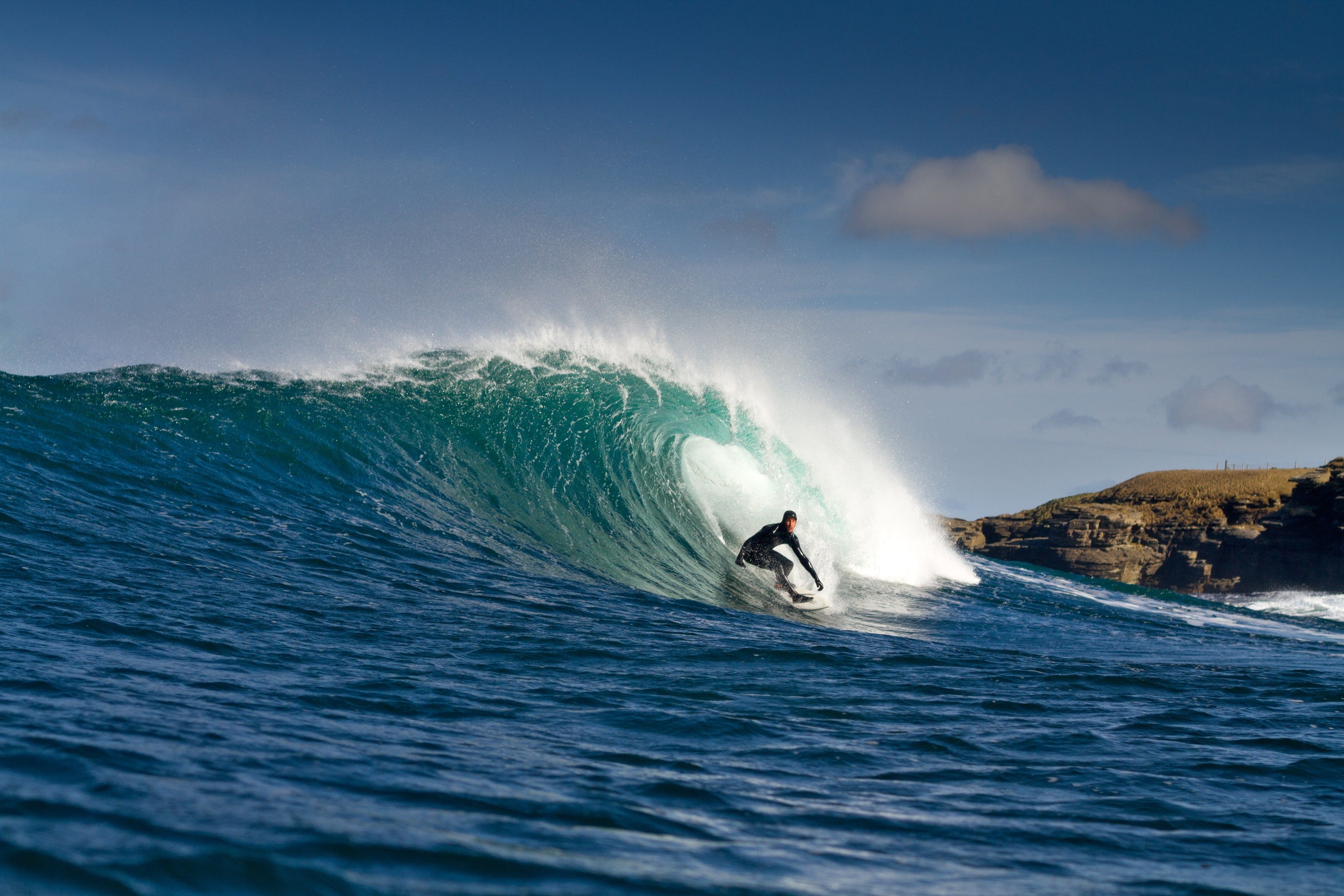
There’s a stretch of the north Cornwall coast where people paddle out into the North Atlantic in the dead of winter. It’s not the image of England we might first imagine, but it’s the very real place and way of life that inspired the brand Finisterre.
The company takes its name from Finisterre, one of the sea areas in the Shipping Forecast — the beloved broadcast that has been read out the same careful way for a hundred years. Spend any time with founder Tom Kay and you soon realize that nothing the brand does looks accidental. Twenty-three years on, the coastal clothing company remains deeply tied to the place where it began.
After twenty-three years as a fixture in the UK, Finisterre has only recently arrived in America in earnest. I’d mostly seen it from a distance, in passing online, without a real feel for the product. This week I am wearing the swim trunks in Hawaii and at home I love the recycled fleece jacket for beach days. Not to mention the robust Finisterre raincoat is an important part of my kit for adventures in Scotland, Iceland, and Scandinavia. The brand has become a mainstay of my everyday life, to which I can’t imagine a more significant endorsement.
Finisterre is just an under-appreciated brand that cares about the right things. Quality product. Fair prices. Good design and most importantly, good values. Tom’s commitment to environmental stewardship is important. Finisterre clearly takes some inspiration from Patagonia, but it does things its own way. Besides, Patagonia is designed to inspire brands to be more thoughtful and sustainable. It’s a feature, not a bug.
When I emailed to set up a conversation, the reply came straight from Tom — he still uses the original address from the early days. Partway through our call he reached off-camera and produced the very first product the company ever made, a fleece he built more than two decades ago for pulling on in the car park after a cold-water surf.
What interested me most wasn’t the product, though. It was how Finisterre has grown without drifting very far from where it started. That’s the question Tom has been wrestling with for more than two decades, and it’s what I most wanted to talk to him about.
On the north Cornwall coast, technical clothing isn't a trend — it's a daily necessity. Finisterre's product carries that same practicality, paired with genuine design sense. It's rare to find a founder and a company who care about the right things, and those are exactly the people I love to highlight and support. Our Q&A is below. I hope you enjoy it.
ACL: You’re in St. Agnes. How much did that coastline shape the brand?
TK: We’re on the north coast here, built on the side of an old tin mine, with the sea a couple of hundred meters away. I’m originally from the East Coast, but I always had a connection to the sea, and I spent a lot of my teens down here lifeguarding and teaching surfing. The surf was the big attraction, and then it became the sea itself and being close to it. There’s good energy around here and we draw on that as a brand. When I started, I always wanted it to be a brand where if you ever turned up in person, it would be completely consistent with how we present ourselves on the outside. It’s a beautiful day today, but often it’s pretty rough — it’s the North Atlantic. That environment is very tangible in terms of where the business sits, and it’s important to me that the place and the brand are the same thing.
Where did it actually start? Was there one product, one thing you couldn’t find?
Our first product was a fleece — I’ve actually got the original right here, it’s about twenty-three years old and still going strong. I’d studied marine biology and followed the sea all my life; I knew nothing about business or design, but I knew there was a need. Back then there was none of this product around. When you got out of the sea on a freezing February day, you needed something to put on while you were getting changed in the car park. That was it. It mattered to me that the brand started from a real need, and not as another label making t-shirts and hoodies. It began as a three-page website above a surf shop just down the road here in St. Agnes — this was the dial-up era, you had to get your housemates off the phone to get online. Because of the story behind it, we gave money to local ocean conservation charities from the start. The product was well-made, and it grew from there.
The big surf brands you grew up with are mostly gone now. What were they missing?
The brand was born from a love of the sea and a belief that there was a better way to make products. My formative years, fifteen or sixteen, were all about surfing — but I was doing it over here where it was freezing and raining, with frost on the ground. There’s a real romance to that kind of surfing. The big brands back then weren’t making anything relevant to me: no knitwear, no sweaters, no jackets, just bikinis and board shorts. And it wasn’t only the product — it was how product was made, the transparency, the fabrics. Those late-90s brands we all grew up with were flying so high, and they’re no longer around. I think they became so widely distributed that they lost touch with their core audience. We always tried to use our brand as an example of what could be done in the industry — to drive change and have a positive impact, while being honest that we don’t have all the answers and we’re not perfect.
Where does the name come from?
Finisterre is one of the sea areas in the BBC Radio 4 shipping forecast — it means lands end of the earth. The forecast is, I think, the longest-running in the world. It started in the 1920s, when there were so many shipwrecks and navigation was still in its infancy, so they began broadcasting it to help people out at sea. The sea areas have names most people have never heard of — headlands, sandbanks, rivers. It’s read in this very formulaic way: “westerly three, decreasing four, rain later, good becoming fair.” If you were out at sea you’d know exactly what was coming. I remember listening to it in my parents’ car, imagining boats miles offshore. What’s interesting is that loads of people who listen have never been to sea — they call it the forecast for romantics, poets and insomniacs. There are whole books written about it now; it’s a British institution. We can tell stories and pull people in, but underneath there’s real innovation and a pioneering ethos.
You’re twenty-three years in. What have you chosen not to do?
It depends who you ask, but as the founder — and this is my life’s work — I’m really proud of where it stands. Some of those early decisions were hard. Trying to use recycled fabrics in 2009, when no one was doing that, and then having to explain it to customers and retailers — those were difficult conversations. The easy thing would have been to say, here’s some cheaper stuff, let’s go. From a pure growth point of view we’ve grown in the right way, but as a brand it feels pretty tight in terms of who we are. There are brands that got many times bigger in a fraction of the time — but that wasn’t why we started. We’re ambitious about growth and new markets, but ambitious about what that actually means.
Does being in the UK, rather than coastal California, give you a different perspective?
I think it does. There’s a real romance around the UK as a seafaring nation — fishing, smuggling, all of it — and a lot of it lives in the British coastline, particularly in the southwest, particularly in Cornwall. The brand talks to that, and you can bring it to life in product that genuinely does what it says: functional knits, sweats, jackets, waterproofs, wetsuits. When the product is consistent with that narrative, it’s powerful, because it’s true to what we believe. Being based here isn’t always easy — if we were in London or Bristol we’d be closer to the trends — so we’ve had to work at it, and we’ve got a small London office now. But from a founder’s point of view, I’ll always want that brand-and-sea connection first, and work at the rest.
Where do you see Finisterre going?
I often say it feels like we’re just getting started, which is exhausting and exciting at the same time. Because our purpose is the sea and building better products, it’s never a fixed point — you’re never finished. So whether that’s leaning further into activism, being more vocal around regeneration, or growing, it keeps going. We’re getting really good traction in the US and Canada now, and in the Pacific Northwest, which has been a thrill to see. I don’t know exactly what that means in terms of size or scale, but as long as we’re true to the communities we’re talking to, I’m happy. Be who you are and have that integrity — in the product, in your values, as an organization and as people. As a founder, you couldn’t ask for more than that.


